Emerging Statistical Alignments in Deck Composition Across Point Total and Ranked Hand Variants at Licensed Facilities
Written by Nils Müller · Oct 7, 2026

Emerging Statistical Alignments in Deck Composition Across Point Total and Ranked Hand Variants at Licensed Facilities
Statistical convergence appears when deck composition changes produce overlapping probability adjustments in point total mechanics and ranked hand formats at licensed gaming sites, and researchers track these patterns through shared variance models that connect card removal effects across both systems. Data from multi-deck environments shows how depletion of specific ranks alters expected values in blackjack-style point totals while simultaneously shifting equity calculations for poker-style ranked hands, and this dual impact creates measurable alignment points where strategies from one format begin to inform decisions in the other.
Deck Composition Dynamics in Point Total Systems
Point total games rely on cumulative card values that shift as high or low cards leave the deck, and studies document how these removals create non-linear probability changes that accelerate near the end of a shoe. Observers note that removal of face cards increases the frequency of low totals while decreasing the likelihood of strong hands, whereas depletion of smaller cards produces the opposite effect and raises the proportion of stiff totals that require precise decision thresholds. Research indicates these patterns follow binomial distributions that researchers model with hypergeometric sampling to predict remaining deck states at any given penetration level.
Licensed facilities maintain records of shuffle cycles and penetration rates that allow analysts to correlate deck depth with outcome frequencies, and figures from regulated cardrooms reveal consistent convergence between theoretical models and observed results across thousands of rounds. Those who study these systems find that point total adjustments become most pronounced when the ratio of remaining high cards to low cards deviates beyond established baselines, prompting players to modify hitting and standing thresholds accordingly.
Ranked Hand Formats and Parallel Composition Effects
Ranked hand formats such as seven-card stud and community card variants experience equity shifts when specific ranks or suits diminish, and these changes interact with point total mechanics when games share the same card pool or adjacent tables draw from similar shoe compositions. Analysts observe that removal of suited connectors reduces flush probabilities while simultaneously lowering the value of straight draws, and this same depletion alters point total calculations by changing the distribution of face card values that contribute to blackjack totals or dealer bust rates.
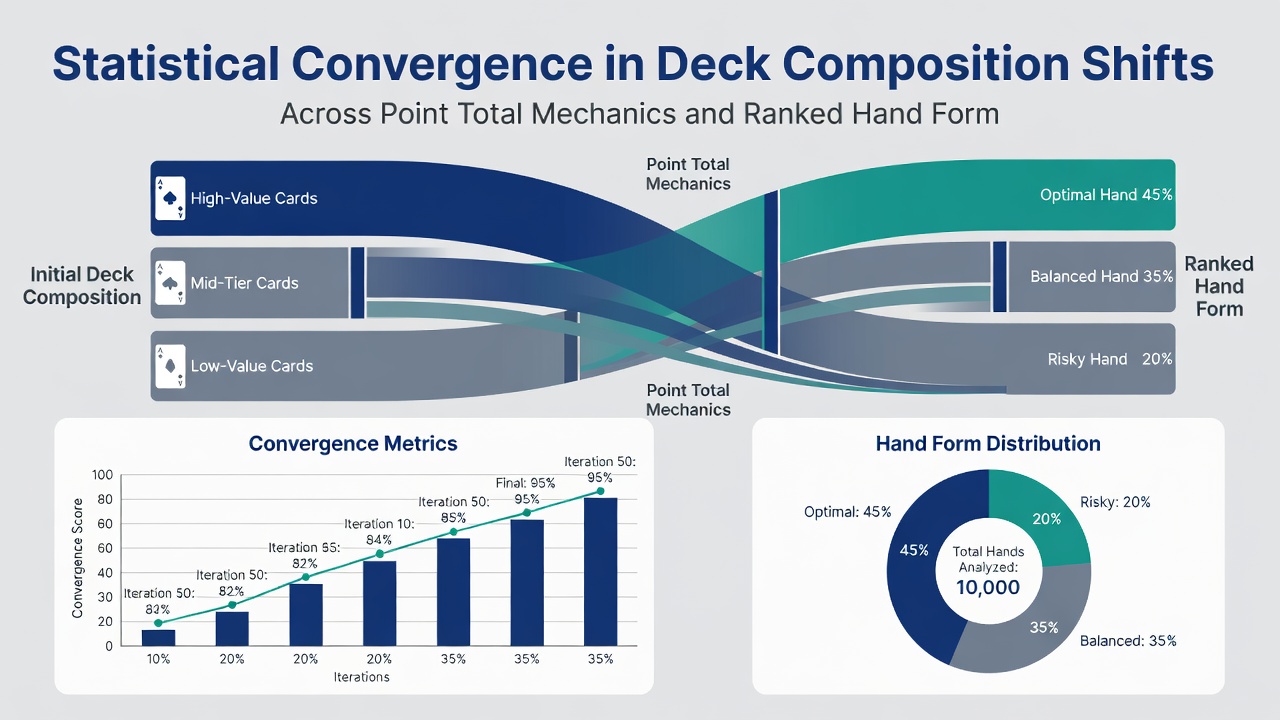
What's interesting is how these overlapping effects create statistical convergence zones where a single card removal produces measurable impacts on both point totals and hand rankings at once. Data collected at licensed venues demonstrates that the correlation coefficient between these two outcome classes increases as deck penetration deepens, and models built from this data allow for predictive adjustments that apply across format boundaries.
Regulatory Context and October 2026 Developments
Regulatory updates scheduled for October 2026 introduce new reporting requirements for deck composition tracking at licensed sites, and these standards require operators to document variance metrics that connect point total and ranked hand outcomes. Government agencies in multiple regions now mandate quarterly submissions that include penetration data and frequency distributions, which in turn feed into larger industry databases used by researchers to refine convergence models. According to reports from the Nevada Gaming Control Board, facilities that implement unified tracking systems show improved alignment between observed results and statistical forecasts across both game categories.
Academic analyses from institutions such as the University of Nevada, Las Vegas Center for Gaming Research further illustrate how these regulatory changes accelerate the identification of convergence patterns, and the resulting datasets enable more precise modeling of how deck shifts propagate through mixed-format environments. Those who examine the October 2026 compliance data note that sites adopting integrated monitoring report tighter confidence intervals around predicted outcome distributions.
Shared Statistical Models and Practical Applications
Shared statistical models combine hypergeometric sampling with regression techniques to map deck composition changes onto both point total expectations and ranked hand equities, and these frameworks reveal convergence thresholds where adjustments in one system reliably predict changes in the other. Analysts apply these models to live dealer scenarios where multiple tables operate from synchronized shoe cycles, and the resulting predictions help operators calibrate minimum thresholds and maximum bet limits that reflect the combined risk profile.
Evidence from industry reports shows that facilities using these integrated approaches experience reduced variance in hold percentages across game types, and the patterns hold across different regulatory jurisdictions including those overseen by the Alcohol and Gaming Commission of Ontario. Researchers continue to test model robustness by comparing pre- and post-October 2026 datasets to isolate the impact of enhanced composition reporting.
Conclusion
Statistical convergence in deck composition shifts continues to shape how point total mechanics and ranked hand formats interact at licensed gaming sites, and ongoing data collection through regulatory channels supports increasingly refined predictive frameworks. The alignment of probability adjustments across these systems provides operators and analysts with tools to anticipate outcome distributions based on shared deck states, and future reporting requirements will likely strengthen these connections further as datasets expand.